
Scrap or Save? The Real Repair-vs-Replace Maths for a Volkswagen Golf Engine Failure
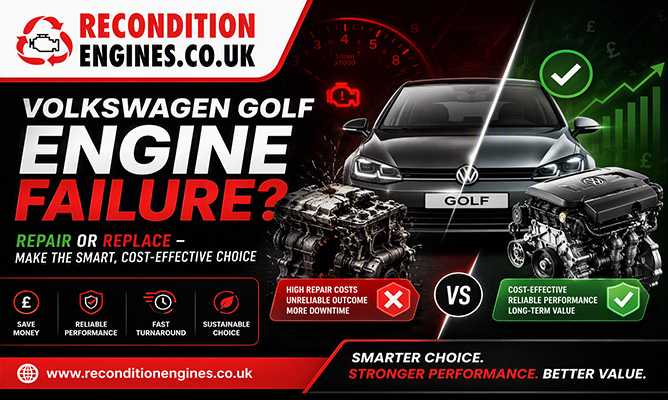
Volkswagen Golf Engine Failure UK: The Cheapest Fix Isn’t Always Best
A failed engine makes any Volkswagen Golf feel finished, and a scrap offer can look like the simplest way out. But scrap value prices the car as metal — it ignores the working suspension, the tyres you replaced last year, and the clutch that’s barely run in. This guide sets out the actual repair vs replace maths for a used Volkswagen Golf engine failure, how to read the symptoms correctly by engine type, and realistic UK costs across the used, reconditioned, remanufactured and dealer routes.
A Dead Engine Doesn’t Mean a Dead Car
A failed engine makes any Golf feel finished, and a scrap offer can look like the simplest way out. But scrap value prices the car as metal — it ignores the working suspension, the tyres you replaced last year, the clutch that’s barely run in, and the fact that everything except the engine is sound.
A clean 2016 Golf 1.4 TSI engine with an isolated CAXA or EA211 engine fault can genuinely be worth saving — the question is whether the numbers actually support it, not whether it feels emotionally worth it.
It’s worth being honest about the emotional pull here too: a scrap offer arrives quickly, feels final, and removes the uncertainty of a repair decision. That convenience has a price, though, and it’s usually a price the scrap dealer benefits from far more than you do.
What the Scrap Offer Doesn’t Account For
Before accepting any scrap valuation, total up what you’ve spent on the car in the last 12–18 months: a recent clutch, fresh tyres, a new MOT, or other work. That spending doesn’t transfer to a replacement vehicle, and scrap dealers have no reason to remind you of it.
This total is often larger than owners expect once brake pads, a set of tyres, and a recent service are added up together — and it’s money that’s already sunk into the car regardless of what happens to the engine.
Reading the Symptoms Correctly
Different Golf engines fail in different ways, and the fix depends entirely on which fault you’re actually looking at:
- Cold-start rattle for two seconds — inspect the chain, guides and tensioner before assuming anything worse.
- White smoke plus coolant loss — test the head gasket and cylinder head condition.
- Blue smoke under boost — check turbo seals and piston rings.
- Metal in the oil — price a rebuild before spending on smaller repairs; this is a sign the internals are already compromised.
Timing chain wear on the petrol range is widely reported between roughly 80,000 and 120,000 miles once servicing has slipped — worth checking proactively at that mileage even without symptoms yet.
Fault codes alone don’t condemn an engine. Compression, leak-down and oil pressure tests carry more weight than a warning light, and a specialist should base any replace-or-repair recommendation on those results, not the code reader alone.
Why Diesel and Petrol Golfs Need Different Questions
The 1.6 and 2.0 TDI diesel range brings its own concerns — injector seal failures, EGR carbon build-up, and DPF blockages from short-trip use are all common enough to ask about specifically. These faults can present with symptoms that look like a failing engine (rough running, power loss, warning lights) while being considerably cheaper to fix than the petrol range’s chain or head gasket issues.
Whatever engine you have, ask your specialist to name the specific fault rather than accepting a general “the engine’s on its way out” verdict — a vague diagnosis is often a sign that proper testing hasn’t actually been done.
The Actual Cost Comparison
| Option | Price Range | Warranty | Best For |
| Used engine | £1,000–£1,900 | 3 months | Owners planning to sell within a year or two |
| Reconditioned | £2,000–£2,800 | 6–12 months | Keeping the car for the medium term |
| Remanufactured | £2,900–£3,800 | 12–24 months | Long-term ownership |
| Dealer replacement | £5,500+ | Dealer terms | Cars still under factory support |
Compare the mid-range of reconditioned Volkswagen Golf engine figure against your car’s realistic private-sale value with a sound engine — not its scrap value. On most well-kept Golfs from this era, that comparison favours repair.
A Simple Way to Compare Fairly
- Get a written repair quote itemising parts, labour and warranty.
- Get a written scrap valuation on the same day, from the same market conditions.
- Check a private-sale valuation guide for your Golf’s model, age and mileage with the engine fixed.
- Add up recent spend on tyres, brakes, clutch or servicing that would be lost if you scrap the car.
- Compare repair cost against (private-sale value + recent spend), not against the scrap figure alone.
What Happens if You Decide to Repair
Once you’ve decided repair makes financial sense, treat the choice of specialist with the same care as the choice itself. Ask how many Golfs with your specific engine code they’ve worked on, whether they can show you the compression and leak-down figures that informed their recommendation, and what the warranty actually covers if the repair doesn’t hold.
It’s also worth asking whether they recommend renewing any other wear items — a water pump, timing components, or engine mounts — while the car is already stripped down. Doing this at the same time is almost always cheaper than a second labour charge for a separate job a few months later.
Frequently Asked Questions
At what point does a scrap offer genuinely make more sense than repairing?
When the rest of the car needs significant work too — failed MOT items beyond the engine, high mileage on the gearbox, or bodywork corrosion — the maths shifts quickly. If the engine is the only major issue, repair usually wins on a car in otherwise good condition.
Is a used engine ever a good idea on a Golf, or should I always recondition?
A used engine can make sense if you’re planning to sell the car within a year or two and want to minimise spend. For a car you intend to keep, the longer warranty on a reconditioned or remanufactured engine is usually worth the extra cost given how much more driving you’ll do on it.
How do I get an honest scrap-versus-repair comparison rather than a sales pitch?
Get a written repair quote and a written scrap valuation on the same day, then compare the repair cost against your car’s realistic private-sale value with the engine fixed — not against the scrap figure alone, which is designed to look attractive by comparison.
Does timing chain wear affect all Golf engines the same way?
No — 1.2 TSI, 1.4 TSI, 1.6 TDI and 2.0 TDI units all have different failure patterns and typical mileage windows. Ask your specialist to confirm what’s known for your specific replacement Volkswagen engine code rather than applying a blanket answer to the whole range.
Should I get a compression test even if there’s no smoke or rattle yet?
If your car is approaching the 80,000–120,000 mile range mentioned above and hasn’t had a chain inspection, yes — catching wear before symptoms appear is cheaper than waiting for a failure, and it gives you time to plan the repair rather than being forced into an urgent decision.
Is it worth asking a specialist to name the exact fault rather than a general verdict?
Yes — a vague “the engine’s on its way out” without compression, leak-down or oil pressure figures attached is often a sign proper testing hasn’t happened. A named fault (chain, head gasket, injector seals) lets you get a second opinion and compare quotes properly.
Bottom Line
A failed engine feels like the end of the car, but for a Golf that’s otherwise sound, it usually isn’t. Get a genuine repair quote alongside the scrap offer, account for what you’ve already spent keeping the car roadworthy and let the real numbers — not the emotional weight of a dead Volkswagen Golf engine — make the decision.
Get a written repair quote and a written scrap valuation on the same day, then compare them against your car’s realistic private-sale value.
Editorial note: cost figures reflect UK independent trade ranges observed in 2026 for common Golf petrol and diesel engines and will vary by supplier, region and vehicle condition.