
Reconditioned BMW 335d Engine Reliability: What Actually Goes Wrong and What a Good Reman Engine Should Fix

The Real Story on Reconditioned BMW 335d Engine Reliability
Reconditioned BMW 335d engines (N57 3.0-litre diesel) can provide dependable service when properly remanufactured to address inherent design weaknesses. A quality remanufactured engine or replacement BMW 335d engine typically resolves the most common issues through full disassembly, component replacement, and precision machining. Poorly reconditioned or used engines often fail early due to skipped processes. Real-world data from UK workshops shows major warranty claims for sub-standard units running 15-25% within the first 12-18 months.
Why Can’t You Trust the Reconditioned BMW 335d Engine Reviews You’re Finding Online – and What Should You Look for Instead?
The vast majority of glowing feedback for reconditioned BMW 335d engine, replacement BMW 335d engine, or remanufactured engine options comes from seller-controlled platforms. These sites write, host, and moderate the content, creating an ecosystem of manufactured social proof that buries negative experiences. Genuine independent reports differ sharply by focusing on measurable tolerances, rejection logs, and failure statistics rather than star ratings.
Look instead for suppliers who publish detailed QC processes, including bore measurements, crank end-float checks, and pressure testing. Demand evidence of parts replaced and tolerances achieved.
Independent workshop data reveals that failure patterns for this engine code are rarely shared publicly because it risks supplier relationships — key reason real reliability insights stay behind closed doors.
What Are the Known Failure Rates and Weak Components of the Reconditioned BMW 335d Engine That Affect Every Buyer?
Reconditioned BMW 335d Engine units inherit the N57’s documented weaknesses unless fully addressed during remanufacturing. Here is a data-driven breakdown based on UK workshop observations:
| Component | Failure Mode | Frequency (approx. %) | Preventable With Proper Reman |
| Timing Chain | Stretch & guide rail wear | 35-50% by 100-150k miles | ✓ Full kit replacement + tensioner |
| Swirl Flaps | Breakage into cylinders | 20-30% | ✓ Blank or delete + manifold clean |
| EGR Cooler | Leaks & potential fire risk | 15-25% (recall-related) | ✓ Replacement (per BMW SIB) |
| HPFP (High Pressure Fuel Pump) | Failure contaminating fuel system | 10-20% | ✓ Replacement + system flush |
| Turbochargers | Bearing wear & boost issues | 25-40% at high miles | ✓ Rebuild or upgrade |
BMW issued technical service bulletins and recalls (e.g., EGR cooler and HPFP for N57 engines) confirming these as systemic issues.
Workshop records show that engines with incomplete addressing of these points often return for costly repairs far sooner than properly remanufactured alternatives.
How Does a Remanufactured BMW 335d Engine Actually Perform vs a Reconditioned Unit Under Real UK Driving Conditions?
A full remanufactured engine for the BMW 335d significantly outperforms basic reconditioned or rebuilt BMW engine options in UK conditions involving road salt, stop-start urban traffic, and mixed motorway running. Reman units typically reach 150,000–250,000+ miles reliably; basic reconditioned ones often show stress by 60,000–100,000 miles.
Genuine remanufacturers strip the engine completely, measure every critical tolerance (crank journals, bearing clearances, cylinder bores), and replace wear items a simple reconditioner usually skips. UK stop-start cycles accelerate EGR and DPF-related issues in lesser-prepared units.
Long-term garage data indicates that only engines rebuilt to OEM-plus tolerances survive repeated short trips and cold starts without accelerated bearing or chain wear.
What Does a Reconditioned BMW 335d Engine Warranty Actually Cover and What Exclusion Traps Should You Watch For?
A reconditioned BMW 335d Engine warranty must comply with the UK Consumer Rights Act 2015, requiring goods to be of satisfactory quality and fit for purpose. Many “12 months” warranties sound good but include heavy exclusions.
Typical coverage is limited to major internal failures, but watch for verbatim red flags such as:
- “Mileage cap of X miles”
- “Excludes damage caused by improper fitting”
- “Customer responsible for return shipping and labour”
- “Void if oil change intervals not strictly followed with approved oil”
Always request the full terms before purchase and confirm fitting by a competent garage.
Experienced suppliers highlight these exclusions upfront — a strong signal of transparency.
What Is the Critical Timing Chain Failure Threshold for the Reconditioned BMW 335d Engine and How Is It Fixed?
The reconditioned BMW 335d Engine (N57) commonly develops timing chain stretch and guide rail degradation, often becoming audible around 80,000–150,000 miles depending on service history. Early N57 variants are more prone; later ones improved slightly but still require attention.
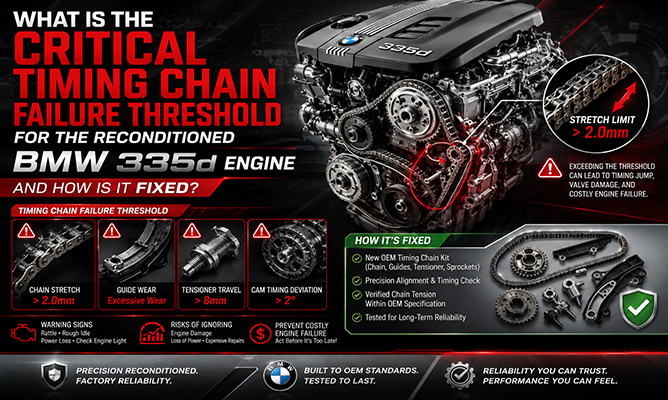
A proper reman process replaces the entire chain kit, tensioners, and guides while the engine is apart. Skipping this leaves a hidden time bomb that can cause catastrophic valve-piston interference.
Rejection logs from quality rebuilders frequently cite units with excessive chain slack that would have failed dramatically within 12–20k miles if sold as-is.
How Does a Replacement BMW 335d Engine Impact Long-Term ULEZ Compliance and Real-World Fuel Economy?
A well-executed replacement engine or remanufactured engine maintains ULEZ compliance provided the DPF, EGR, and emissions components are correctly reinstated or upgraded to match the vehicle’s original specification. Post-replacement real-world fuel economy on HonestJohn-style data typically returns to 35–45 mpg combined with proper servicing.
Resale values on AutoTrader UK hold better for vehicles with documented high-quality engine work versus high-mileage originals with service gaps.
Specialist fitting teams stress the importance of full emissions system testing after installation to avoid future compliance failures.
The Rejection Story
We recently received a low-mileage core for a reconditioned BMW 335d Engine. On disassembly, we found severe crankshaft bearing wear with metallic debris and timing chain stretch beyond acceptable limits. This unit would likely have suffered catastrophic bottom-end failure within 8,000–15,000 miles under normal UK driving. We refused the core outright. That decision protects buyers — and is the kind of transparency that separates genuine remanufacturers from the rest.
Explore More
- Remanufactured BMW 330d vs 335d Engine Differences and Which Lasts Longer in UK Conditions
- Supply and Fitting Costs for Replacement BMW 335d Engine – Full UK Price Guide
- How to Spot a High-Quality Rebuilt Engine Before Purchase
- BMW N57 EGR Cooler Recall Explained and What It Means for Your Reconditioned Engine
- Long-Term Reliability of Used Engine vs Remanufactured Options for 3 Series Diesels
People Also Ask
Is a reconditioned BMW 335d engine reliable? Yes, when fully remanufactured with timing chain, swirl flaps, and EGR components addressed. Sub-standard reconditioning leads to high failure rates; quality units routinely exceed 150,000 additional miles.
What are the most common problems with the BMW N57 335d engine? Timing chain stretch, swirl flap failure, EGR cooler leaks, HPFP issues, and turbo wear are the primary concerns. Proper remanufacturing resolves these systematically.
How long does a remanufactured BMW 335d engine last? With correct installation and servicing, 150,000–250,000+ miles are realistic. Basic reconditioned units often fall short due to incomplete work.
Should I buy a used engine or a remanufactured engine for my 335d? A properly remanufactured engine is almost always the safer choice over a used engine, offering known history, updated components, and stronger warranty protection.
What warranty should a replacement BMW 335d engine come with? Look for minimum 12 months unlimited mileage, with clear terms. Reputable suppliers exceed basic legal requirements and stand behind their work.
Do reconditioned BMW 335d engines pass ULEZ? Yes, provided emissions equipment is correctly fitted and tested post-installation. Always verify DPF and EGR functionality.What should I check before buying a reconditioned engine supply and fitting package? Demand full QC documentation, parts replaced list, tolerance measurements, and clear warranty exclusions. Confirm the fitter’s experience with N57 engines.